ENG 151 · LECTURE 02 · READING BOOKLET
Ancient knowledge and practical ingenuity
How people measured, healed, calculated, explained, and preserved what they knew.
Read continuously or use the contents. Select any image to view it at full size.
1. Problems, methods, and surviving evidence
Let us begin with a practical problem. A field must be measured, a storehouse supplied, an injury examined, or a season anticipated. None of these tasks requires people to begin with a modern definition of science. They need a way to act, and they need enough confidence that the action will be useful. Over time, repeated tasks can produce specialized skills, records, procedures, and explanations.
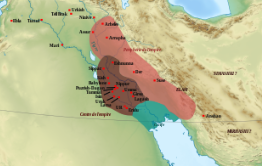
In this lecture, I want us to follow those connections. We will move through early urban societies and then examine several Greek, Hellenistic, Chinese, and Roman examples. These histories overlap. Our route is a way to organize a comparison, not a claim that knowledge passed along one straight road from one civilization to the next.
Mesopotamian cities provide an opening case. Fields, construction, supplies, and calendars demanded coordination. A record could preserve information after the person who collected it had left. Teaching could make a procedure available to someone new. Yet written records capture only part of the work. A potter or metalworker also learns through handling materials and recognizing changes that may be difficult to describe.
This gives us a useful distinction. Someone may know how to produce a result without possessing an explanation that we would accept today. Practical skill is still knowledge. Religious meanings, administrative needs, and curiosity could coexist within the same society. We should resist reducing a whole culture to one motive.
2. What a numerical tablet can tell us
Plimpton 322 is a particularly good object for practicing historical care. The tablet survives, with numbers arranged in columns. Those numbers have mathematical relationships associated with right triangles. From that point, however, we face another question: what was the table intended to do? Scholars have proposed different interpretations. Recognizing a numerical pattern does not settle the purpose of its author. See the Columbia account and the scholarly discussion of its interpretation.
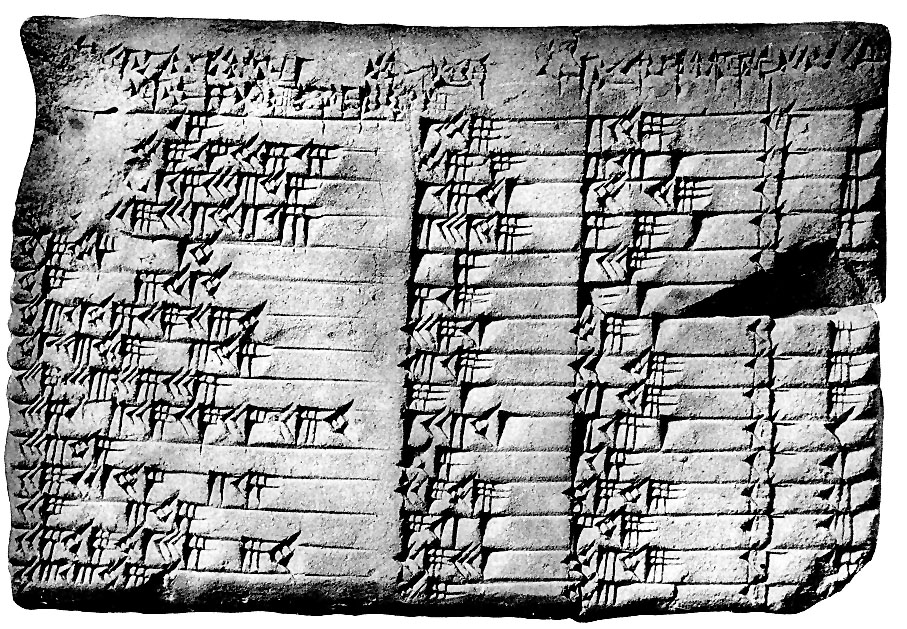
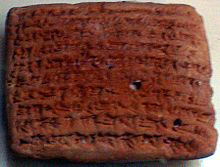
Consider a small example of our own: 3² + 4² = 5², because 9 + 16 = 25. We have checked a relationship between three particular numbers. This calculation is not a row transcribed from the tablet, and it is not a general proof about every right triangle. The example helps us separate three activities: calculating a case, proving a claim, and reconstructing a historical intention.
Celestial records raise a related issue. A sequence of observations can reveal repeating patterns. Those patterns may support calendar calculations and predictions even when the observer explains the heavens differently from us. Babylonian astronomy also existed in settings where divination mattered. Its practical and religious purposes do not erase the care involved in recording and calculation.
Notice what writing contributes here. One person cannot observe for many lifetimes, but a community can preserve observations across generations. The record becomes something that later workers can compare, extend, and reinterpret. We should also distinguish the general history of these records from the precise identification of a photographed tablet; the latter requires object-specific evidence.
3. Measurement, buildings, and standards
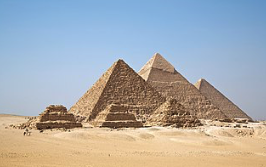
The Egyptian pyramids make organized technical achievement visible. Materials had to be obtained, workers coordinated, and parts brought into a workable arrangement. Surveying and building required measurement. Looking at the completed structure, however, does not give us a complete account of the methods used to make it. An impressive result and a reconstruction of its construction process are different kinds of claim.
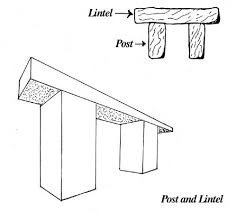
The post-and-lintel drawing illustrates a simple structural arrangement: upright supports carry a member spanning an opening. It helps us talk about loads and openings. We should not mistake this explanatory drawing for evidence that every ancient builder reasoned in exactly the same way. The same caution applies to the familiar 3–4–5 triangle. Its mathematical usefulness is easy to demonstrate; its use at a particular Egyptian building site requires historical evidence.
The Indus world offers a different kind of evidence. Many Harappan bricks show an approximately 4:2:1 relationship between length, width, and height, even though their absolute dimensions varied. J. M. Kenoyer’s discussion of Harappan measurement places this pattern in its archaeological setting.
Shared proportions can make coordination easier: components can be planned, arranged, and replaced with fewer surprises. That is a reasonable way to think about the usefulness of standards. It does not establish the exact intentions of every builder or prove that a single authority imposed the proportions everywhere. Here again, we distinguish the observed pattern from the explanation we propose for it.
4. Recording an injury is already a choice
Now let us change the practical problem. Instead of measuring a field, someone must respond to a person who is ill or injured. Mesopotamian healing could combine remedies, physical treatments, incantations, and ritual. Terms such as asû and āšipu identify kinds of practitioners, but we should not simply translate them into modern professional categories. The British Museum’s account of ancient healthcare helps place the remedies and practitioners in context.
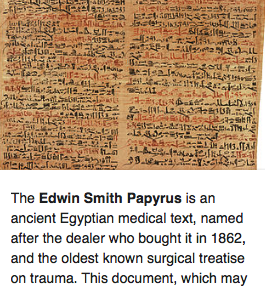
The Edwin Smith papyrus is especially useful because of the way it presents injuries. Cases organize examination, diagnosis, prognosis, and treatment. Such an arrangement gives a later reader a way to follow the description and the judgment. The National Library of Medicine describes the manuscript and its digitization. The image reproduced here is Edwin Smith; it should not be read as an image of the Ebers papyrus.
The Ebers papyrus is a different document, with a wider collection of medical knowledge and remedies. Leipzig University Library preserves and presents it. Comparing the documents is more useful than treating every ancient medical manuscript as an interchangeable example of early medicine.
What can we infer from a recorded treatment? We can establish that a treatment appears in a surviving source. To determine whether it helped patients requires another kind of evidence. Careful observation, a systematic written form, and an ineffective remedy can exist together. That combination should make us curious about the strengths and limits of the practice, rather than forcing us to label the entire tradition either scientific or unscientific.
5. Knowledge in everyday Greek life
In the Greek world we encounter natural philosophers, craftspeople, healers, and religious communities. The category “scientist” does not fit neatly over all of them. Different people had different methods, responsibilities, and audiences. This matters because a history made only from famous philosophical names would miss much of the work that kept daily life going.
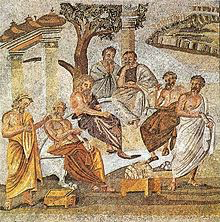
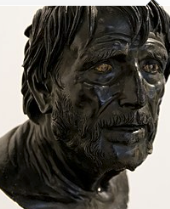
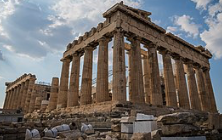
Hesiod’s Works and Days connects agricultural activity with seasonal signs. Parapegmata connect calendar sequences with recurring celestial or weather phenomena. Both remind us that watching the sky could be part of organizing work. The picture of Greek architecture provides a setting; it is not a photograph of a parapegma. The portrait associated with Hesiod is likewise a later representation, not an eyewitness record of the author.
Early Greek thinkers also asked how the world was ordered and how change was possible. They did not give one answer. Water, air, the boundless, elements, and atoms belong to competing accounts. Calling all these thinkers materialists would conceal differences in their questions and explanations. Much of what we know comes from later testimony rather than complete surviving works. The Stanford overview of Presocratic philosophy is a useful guide to that evidence.
6. Explanation, observation, and a coherent cosmos
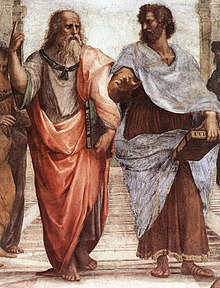
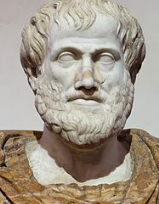
Plato and Aristotle let us sharpen the question of how knowledge is justified. Plato gives mathematics and rational demonstration a prominent place. Aristotle also gives sustained attention to living things and to observation. It would be misleading to turn this into a simple opposition between a person who thinks and a person who looks. Plato emphasizes stable intelligible forms; Aristotle locates form in the things we encounter and investigate. Both sought explanations and asked what makes an account adequate.
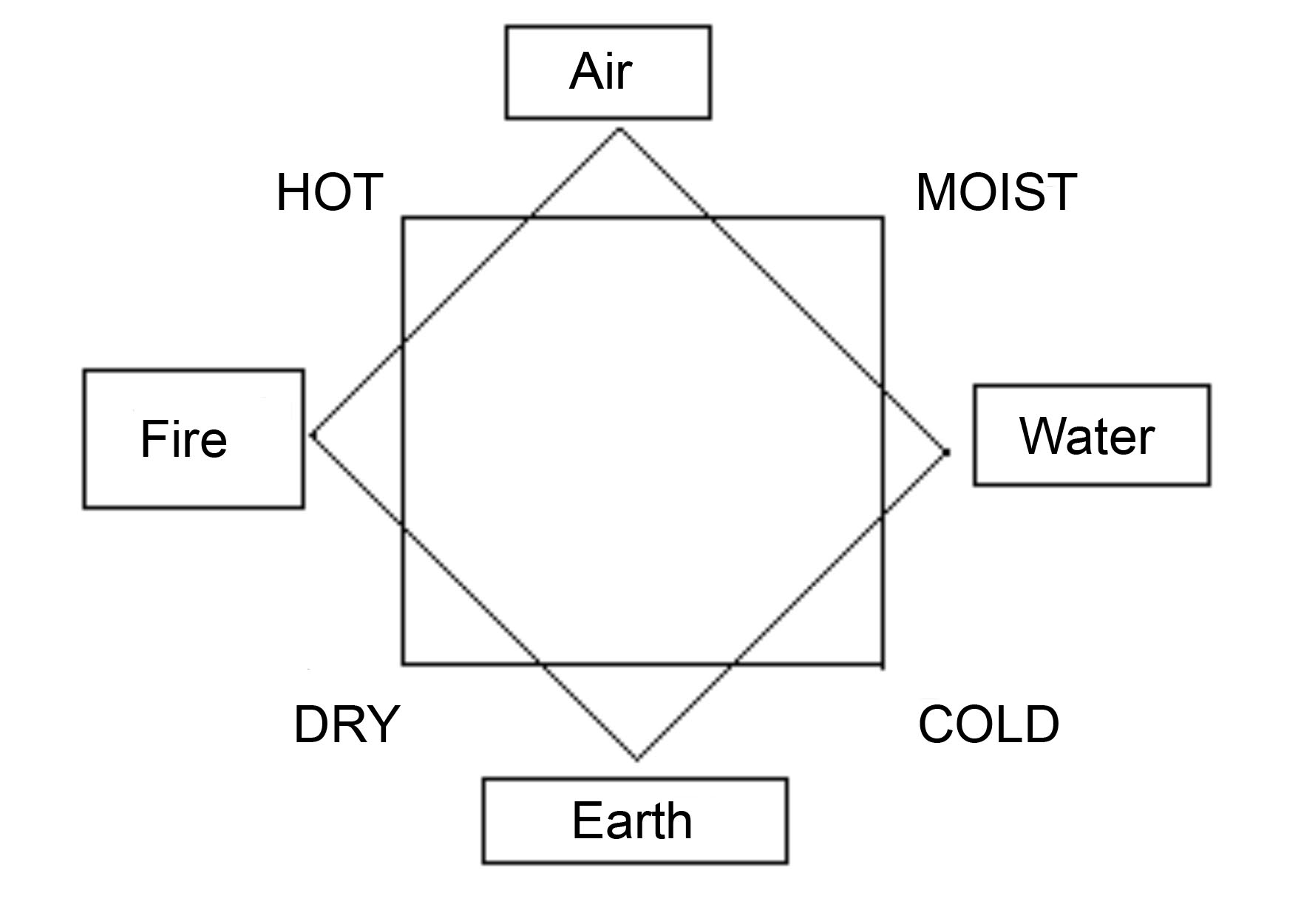
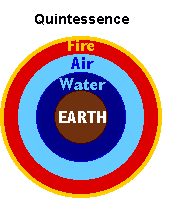
The four-element framework organizes earth, water, air, and fire through qualities such as hot, cold, wet, and dry. This connected familiar experiences of transformation to a general account of matter. We should read “element” in that historical sense. These categories are not early entries in the modern periodic table.
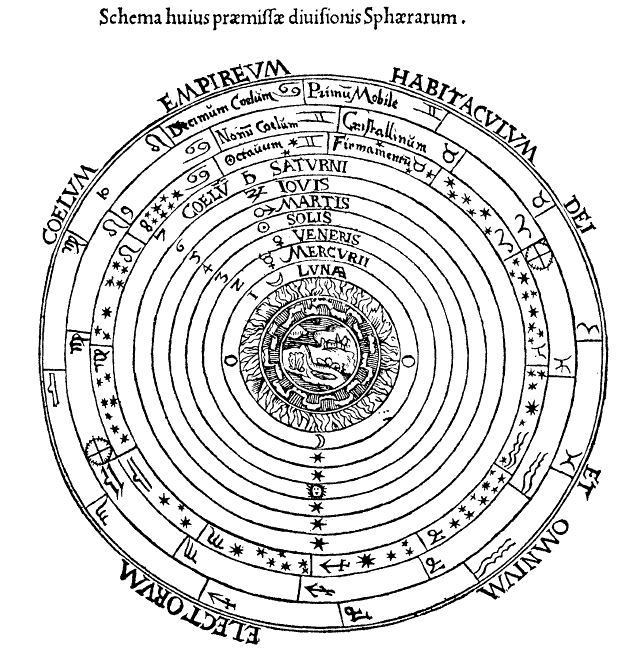
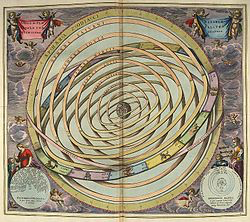
In an Aristotelian account of the cosmos, the region below the Moon is associated with generation and decay. The heavens have a different character, with aether and regular circular motion. Earth occupies the center of the arrangement. The framework makes several kinds of experience intelligible within one ordered picture.
That is also why it is a good teaching case. An explanation can be coherent and influential while resting on assumptions that later investigation rejects. We need to ask both why an account made sense to its users and how its claims could be assessed. The Stanford account of Aristotle provides further context. Raphael’s much later painting of Plato and Aristotle is an interpretation of their intellectual relationship, not a contemporary record.
7. Natural causes and the body
Greek healing had several traditions and kinds of practitioner. The Hippocratic corpus itself is a collection of works rather than a single author’s notebook. In On the Sacred Disease, the author argues that the condition under discussion has a natural cause. That is an important choice of explanation, but it does not automatically make the proposed cause correct.
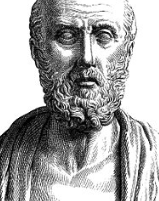
We can connect this to Lecture 1. A claim needs evidence even when it uses natural causes and sounds reasonable. Rejecting one explanation does not establish a replacement. Nor does a plausible account of illness demonstrate that a proposed treatment is effective.
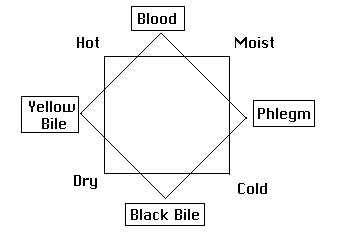
Airs, Waters, Places directs attention to environment and ways of life. Humoral medicine links health to the balance of blood, phlegm, yellow bile, and black bile, associated with different qualities. These ideas shaped later thinking for a long time. We are examining their historical role, not treating the diagram as a valid medical model. Influence, coherence, and correctness are separate questions.
8. Alexandria and the work of preservation
Alexander’s conquests were followed by kingdoms that connected several regions and traditions. Alexandria became an important center of scholarship under the Ptolemies. Learned work required people, collections, training, and resources. We can therefore return to the point emphasized in Lecture 1: decisions by leaders and institutions can create conditions in which knowledge prospers.
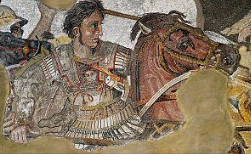
Patronage also invites questions. What work receives support? Who gains access to a collection? What survives when political circumstances change? We do not need a simple answer to recognize that intellectual activity has material and institutional requirements.
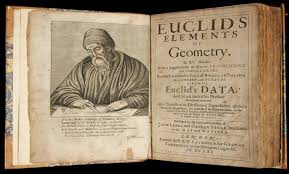
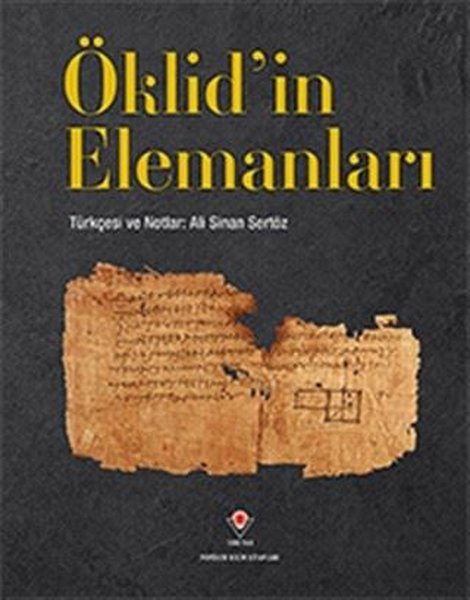
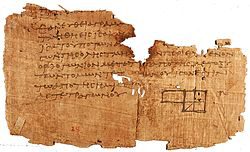
Euclid’s Elements offers a particularly durable example of organized reasoning. Definitions and assumptions support demonstrations. The reader should be able to inspect how a conclusion follows. A proof is powerful within its assumptions, while the applicability of those assumptions to a physical situation can raise a further question.
The papyrus fragment and later editions show different stages in the life of a text. The English and Turkish books make the continuing teaching tradition visible. Copying, translating, explaining, and correcting are active forms of intellectual work. A text does not cross centuries by itself.
9. Archimedes and the useful idealization
Archimedes connects mathematical reasoning with mechanics. His work includes areas, volumes, levers, and floating bodies. Buoyancy relates the upward force on an immersed body to the weight of displaced fluid. This lets us connect a seemingly simple experience in water with a quantitative relationship. See MacTutor’s account of his work. Later accounts also associate him with practical machines. We should distinguish surviving mathematical arguments from stories that accumulated around a celebrated figure. The later painting is part of that remembered image, not a record of his appearance.
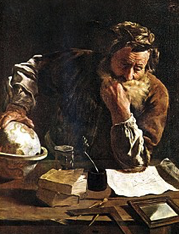
An ideal lever gives us a manageable example. Suppose a load of 100 units acts at a distance of 1 from the pivot. Its force multiplied by its distance is 100. On the other side, a force of 25 at a distance of 4 gives the same product: 25 × 4 = 100. Under the idealized conditions, the lever balances.
Why say “idealized”? We have neglected the weight of the lever and friction at the pivot. We have also assumed a suitable rigid arrangement. The smaller force acts through a larger distance when the lever moves. The example therefore does not promise that a machine gives useful work for free. It shows how a clearly stated model lets us reason about a physical arrangement.
The numerical values here are a classroom example, not reported ancient measurements. What matters is the habit of stating the relationship, applying it consistently, and remembering the assumptions that make it usable.
10. When a calculation becomes a machine
The Antikythera mechanism makes the connection between knowledge and craftsmanship unusually tangible. Surviving fragments preserve parts of a geared instrument associated with the Sun and Moon, lunar phases, calendar cycles, and eclipse predictions. The Greek Ministry of Culture’s description places it in the Hellenistic period and explains its astronomical inscriptions.
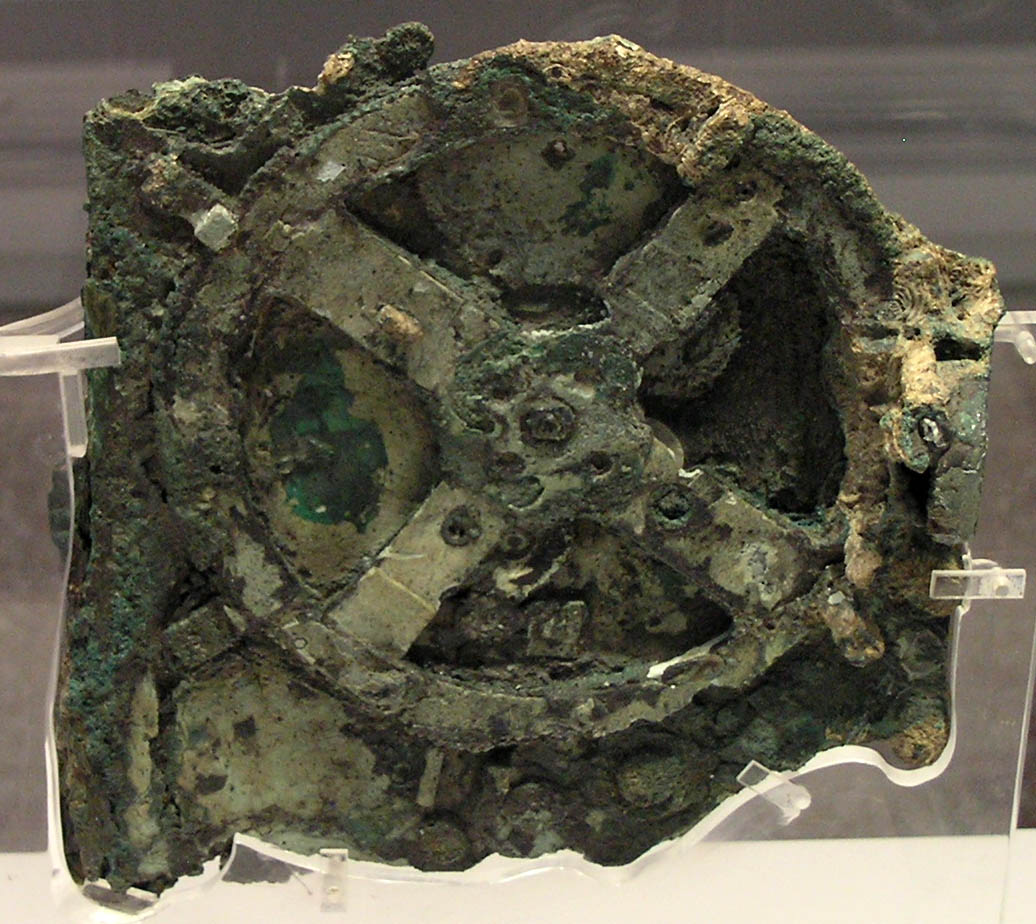
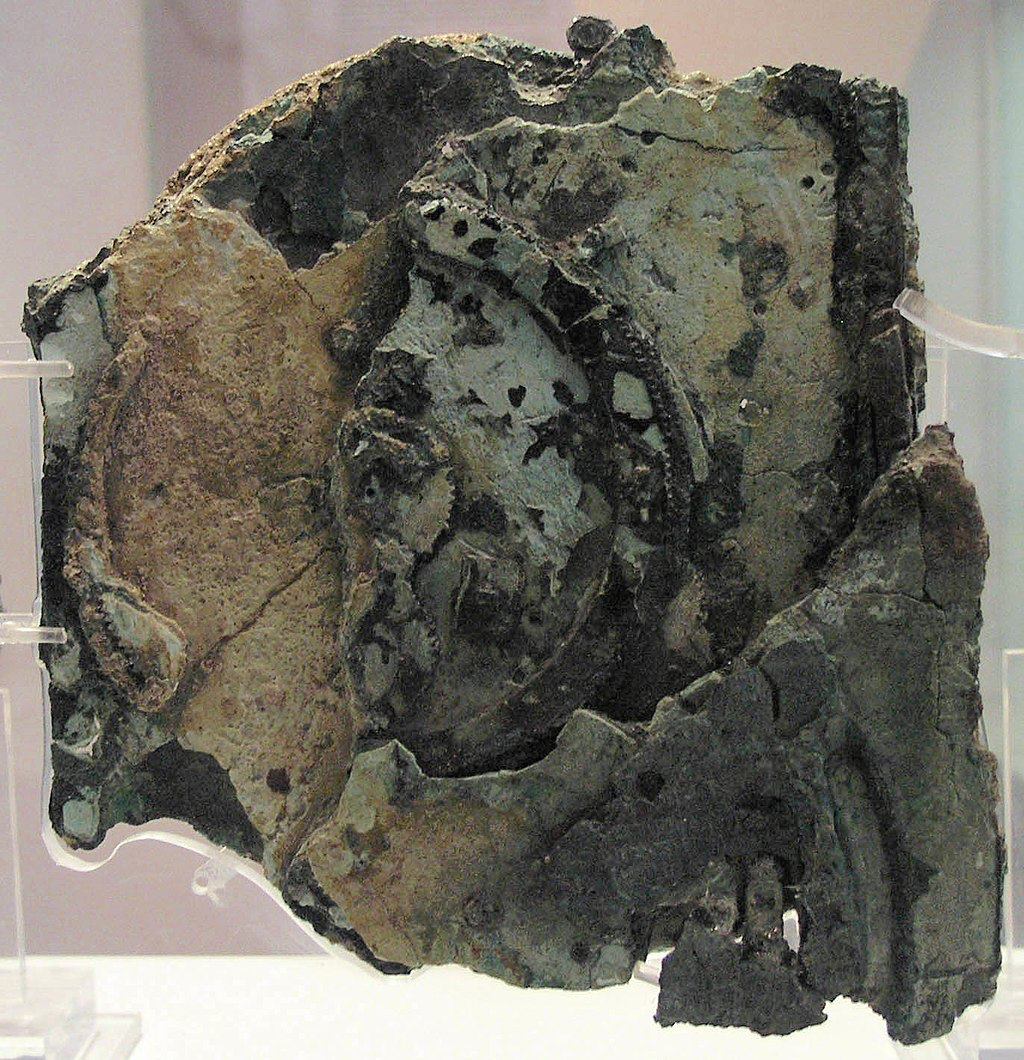
The expression “ancient analog computer” can be helpful if we explain it. A mechanical motion represents a relationship. Gears can make one turn correspond to a different amount of rotation elsewhere. The device is not a digital computer running software in the modern sense. Its achievement belongs to the combination of mathematical relationships, design, and skilled construction.
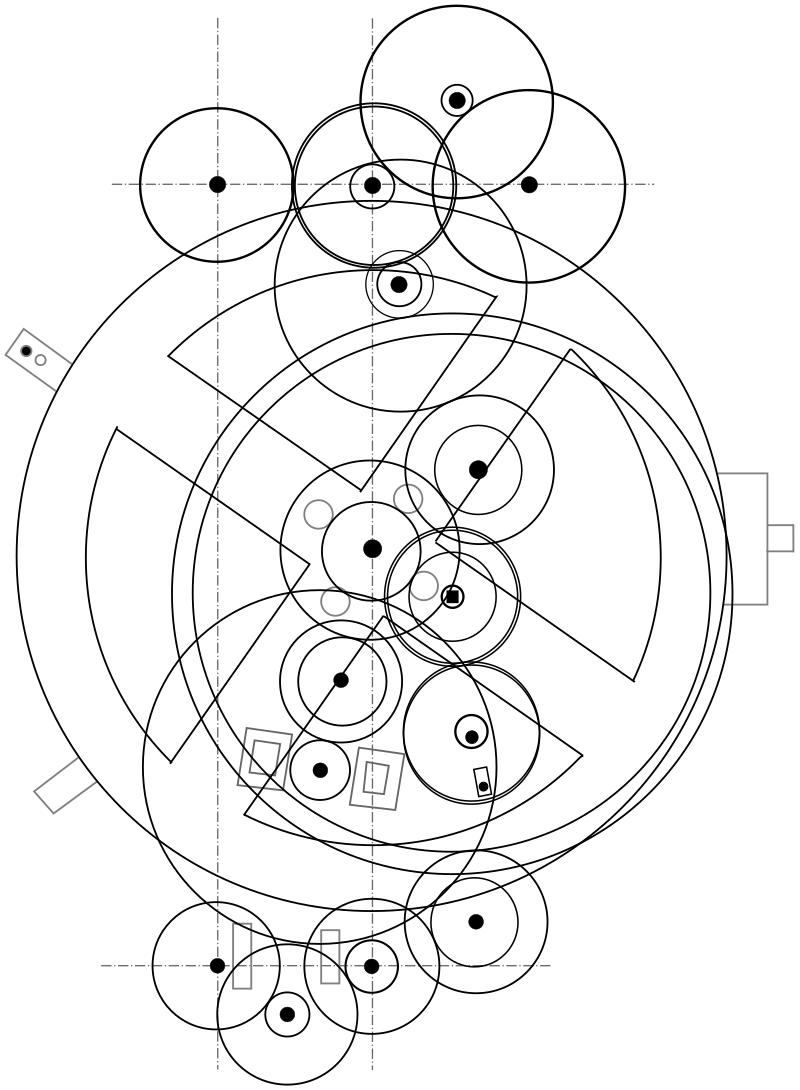
The photographs and the schematic do different jobs. Photographs show surviving material. A schematic presents a reconstruction of how parts may have worked together. Fragments, inscriptions, imaging, and mechanical constraints help researchers assess such reconstructions. Missing parts are a reason to qualify a precise total gear count.
Let us ask the same question we asked about Plimpton 322. What is directly present, and what is inferred? The answer does not diminish the achievement. It makes our account of that achievement more precise.
11. A local observation, a planetary estimate
Eratosthenes is associated with a striking attempt to measure Earth’s circumference. He worked in Alexandria in the third century BCE. The account compares the noon shadow at Alexandria with the Sun’s position at Syene. The original treatise is lost, so later accounts matter to our reconstruction. MacTutor’s biography discusses the method and uncertainties.
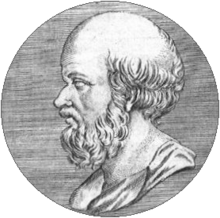
Use the idealized values from the slide: an angular difference of 7.2 degrees and a distance of 5,000 stadia. Since 7.2 divided by 360 is one-fiftieth, the distance represents one-fiftieth of the circumference. Multiplying 5,000 by 50 gives 250,000 stadia. A small angular comparison becomes a statement about a much larger object.
The inference depends on a spherical Earth, nearly parallel sunlight, and an appropriate north–south distance between the sites. Measurements and site alignment introduce uncertainty. Converting stadia into modern units introduces another problem because the historical length of the unit is disputed.
The important lesson is therefore more than an impressive number. We have an observation, a geometrical model, a measured distance, and an inference. We also have a chain of textual transmission. Each part gives us something to inspect before we decide how much confidence to place in a precise result.
12. Chinese mathematics and practical procedures
The Nine Chapters on the Mathematical Art provides another setting for systematic calculation. It brings together practical problems, including fields and exchange. The text developed over time, and commentary helped explain and extend its methods. MacTutor introduces the work and its chapters.
For our own illustrative exchange problem, suppose three baskets of one grain have the same value as five baskets of another. If the rate stays fixed, twelve baskets of the first grain exchange for twenty of the second: twelve divided by three gives four groups, and four groups of five make twenty.
This is not a translation of a particular ancient problem. It is a small example that lets us inspect the structure of a procedure. We must keep the rate and the measures consistent. A basket cannot silently change size halfway through the calculation.
The comparison with other cases should widen our questions. What makes a procedure repeatable? How is it taught? What explanation accompanies it? We do not need to arrange every mathematical tradition on a single ladder in order to recognize the reasoning it contains.
13. A connected Roman world
The Roman Empire connected many regions through administration, movement, and trade. These connections did not provide equal access for everyone. They did create settings in which engineering, medicine, astronomy, and learned writing could continue and circulate in Greek and Latin.
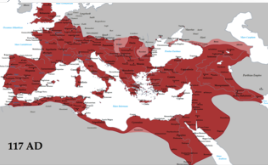
We should avoid describing all Roman-era knowledge as compilation. Pliny compiled natural knowledge, Ptolemy developed mathematical astronomy, and Galen wrote extensively on medicine. Collecting material is itself a task, but it does not describe every form of analysis, observation, or explanation associated with this period.
We can now compare three broad ways of supporting a claim. A record makes observations available for comparison. A calculation or proof exposes a chain of reasoning. A working structure or mechanism shows what an arrangement can do under particular conditions. None automatically answers every question that the others raise.
Take one object from the lecture and ask what it establishes directly. A portrait does not establish a theory. A machine fragment does not preserve every motion of the complete mechanism. A copied text may preserve an argument while leaving questions about its history. This is a useful way to remember the lecture without reducing it to a list of names.
The next lecture follows preservation, translation, teaching, and further inquiry across medieval settings. Aryabhata, Brahmagupta, and Islamic scholarly traditions will enter that chronological discussion. A move into the next period does not mean that earlier knowledge remained unchanged; it gives us an opportunity to study how people transformed it.
14. Review: explain the reasoning
Why is a successful numerical example different from a proof? The example checks a particular case. A proof establishes a conclusion for the cases covered by its assumptions. A table can contain many correct calculations without telling us everything about the general argument or the purpose of its maker.
What supports the Eratosthenes calculation? We need the geometrical model, an angular difference, and a suitable distance. Nearly parallel sunlight and the relationship between the sites matter. Uncertainty in these inputs, together with uncertainty about the historical unit and the surviving accounts, limits any precise claim about accuracy.
Why can a natural explanation still be wrong? Naming a natural cause is a choice about the kind of explanation to seek. Evidence must still support that cause and any proposed treatment or prediction. Coherence and historical influence do not replace that evidence.
What does Antikythera show? It demonstrates a sophisticated connection between astronomical calculation and skilled manufacture. Its fragments also show why historical reconstruction remains necessary. We should distinguish the surviving object from a complete model of its missing parts.
15. Further detail: competing accounts of change
The reference slides preserve more detail about the early thinkers. Thales is associated with water, Anaximander with the boundless, and Anaximenes with air and changes of density. Heraclitus emphasizes change and order. These are brief guides to different approaches, not interchangeable versions of one doctrine.
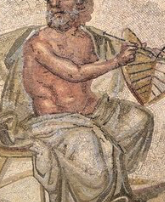
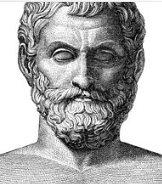
Empedocles proposes four roots and the joining and separating powers of Love and Strife. His thought also connects with reincarnation and opposition to animal sacrifice. Leucippus and Democritus offer an account through atoms and void. The latter should not be mistaken for modern atomic theory established through experiments; its historical importance lies in the explanatory proposal. The Stanford article on ancient atomism develops the distinction.
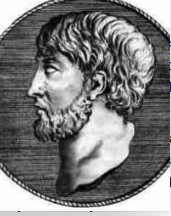
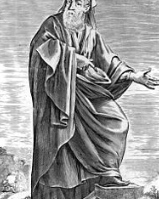
Pythagorean traditions give number, proportion, and harmony a central role. Plato gives geometry an important place in knowledge and demonstration. The often-repeated story of a geometry inscription at the Academy is a later story, not secure contemporary evidence. We can explain the significance of geometry without relying on that anecdote as fact.
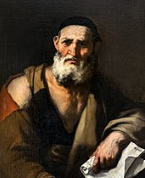
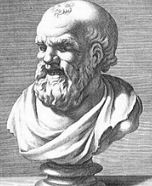
The portraits gathered here are later representations associated with these thinkers. They help identify the traditions we are discussing, but they should not be treated as eyewitness likenesses. Their presence is another reminder that ideas and the images through which we remember them have different histories.
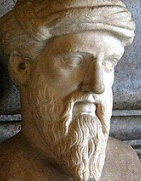
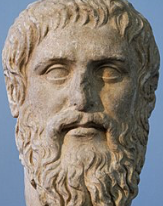
16. Further detail: observation and later images
Aristotle’s investigations include animal structure and behavior, with attention to marine life. His broader natural philosophy connects matter, motion, and explanation. The example is useful because it prevents an easy caricature: an explanatory framework can contain serious observation and still include claims that later work rejects.
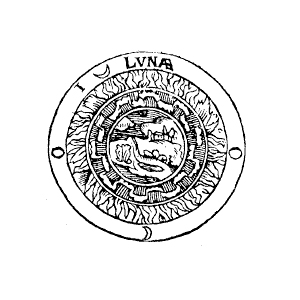
The illustrations of the terrestrial region and celestial order visualize historical models. We should ask when an image was made as well as what it represents. The scheme from Harmonia Macrocosmica dates to 1661, many centuries after antiquity. It is a later representation of a geocentric arrangement, not an ancient astronomical photograph.
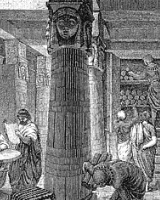
The library scene is also a later representation of an imagined ancient setting. It can prompt discussion about collections and scholarship, but it cannot establish the exact appearance of ancient Alexandria. The distinction matters whenever a compelling image seems to offer more direct access to the past than it actually does.
17. Further detail: the range of Archimedes’ work
The reference material keeps the wider range of mathematical topics associated with Archimedes: areas and volumes, circles and spheres, a parabolic segment, and other geometrical solids. Methods of exhaustion support rigorous comparisons of magnitudes. We can recognize connections with later mathematics without saying that these methods were already modern calculus.
Other work includes bounds for π, the spiral, and ways of expressing very large numbers. Levers and hydrostatics connect mathematical relationships to physical questions. Accounts of the screw, pulleys, and defensive machines belong to the broader practical legacy. Different claims rest on different kinds of source, so a famous anecdote should not carry the same evidential weight as a surviving argument.
18. Sources and further reading
The links below support the historical checks and offer routes into the cases. The lecture’s practical numerical examples are teaching examples, not claims to reproduce ancient measurements or a particular translated exercise.
- British Museum — ancient healthcare
- National Library of Medicine — Edwin Smith papyrus
- Leipzig University Library — Papyrus Ebers
- Columbia — Plimpton 322
- Scholarly survey — Plimpton 322
- Stanford Encyclopedia — Presocratic philosophy
- Stanford Encyclopedia — ancient atomism
- Stanford Encyclopedia — Aristotle
- Greek Ministry of Culture — Antikythera mechanism
- MacTutor — Eratosthenes
- MacTutor — Nine Chapters
- J. M. Kenoyer — Measuring the Harappan World
- MacTutor — Archimedes